THIS MONTH IN SCOPES TRIAL HISTORY
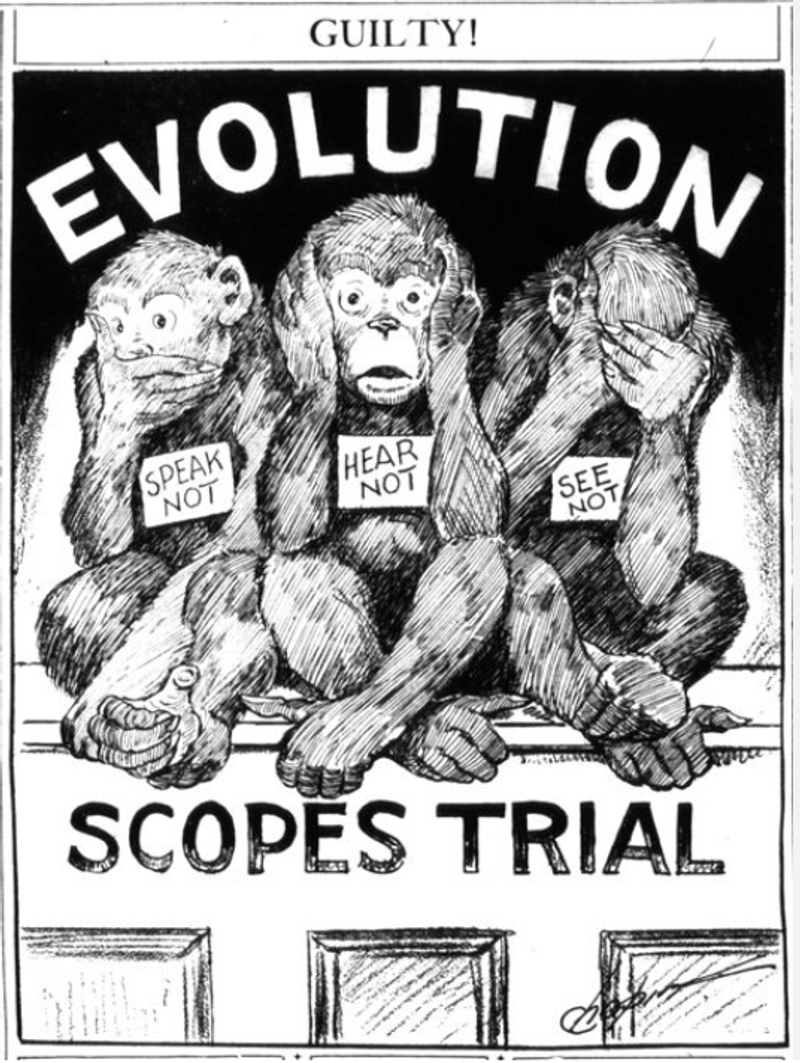
June 1925
Dayton Progressive Club member Walter Nixon reopens Hotel Dayton in anticipation of the crowds that he hopes will visit Dayton for Scopes’s trial.
June 1925
Ira Hicks (1875-1941) writes to his brother Sue that “I have no doubt about the outcome of the [Scopes Trial]. What I fear is the newspapers will color everything to look like a victory for evolution as their sympathy is there. To get the real facts of this case before the people, especially in the north, is going to be a difficult task.”
June 1, 1925
Just two weeks after a Baptist pastor in Chattanooga was forced to resign because of his views about evolution, the most discussed sermon in Chattanooga is “Jesus Was An Evolutionist.”
June 2, 1925
The Nashville Tennessean condemns out-of-state critics of the Butler Act, declaring that “they may have as many spasms as they please… but they will signally fail to impose their own dogmatic cults on the public schools of this state.”
June 2, 1925
Rhea County School Superintendent Walter White tells reporters that he “believes in science as long as it is in harmony with the Bible.”
June 3, 1925
In one of the first major historical articles about Dayton, Chattanooga reporter Nellie Kenyon interviews N.D. Reed, Dayton’s former mayor and postmaster, who admits that
“it is best to hold to the Bible rather than claim kin with monkeys.”
June 4, 1925
In Chicago, William Jennings Bryan announces that he will soon retire from lecturing to work on his memoirs, prompting many to speculate that his speeches at John Scopes’s upcoming trial could be his last public talks.
June 4, 1925
Dayton’s city officials tell the Chattanooga Daily Times that their town will be “ready to entertain 5,000 people” during John Scopes’s upcoming trial.
June 5, 1925
Ira Hicks writes to his brother Herbert that “the advertising [that the Scopes Trial] will bring you will be worth untold money… you will have no trouble in making the evolutionists who take the stand look like a joke.”
June 8, 1925
Despite his football team’s mediocre record, Scopes—now a media darling—is lauded as “the best football coach that Dayton ever had.”
June 8, 1925
English writer H.G. Wells (1866-1946) admits that he would have planned to come to Dayton to help Scopes if he’d “known it was an actual prosecution” and not a “stunt.”
June 9, 1925
While in New York City, Scopes tells reporters that he “wants [his trial] to be an epoch-making case and I don’t want anything to spoil it.”
June 9, 1925
Newspapers report that Scopes “has all the United States and a good part of Europe by the ears” and “frankly admits” that he is “trying to arrange to give Dayton the greatest show on earth. The townspeople expect it of him.”
June 10, 1925
Playwright George Bernard Shaw (1856-1950), who trial instigator George Rappleyea said would come to Dayton for the trial, tells reporters, “What [Bryan] calls fundamental-ism, I call infantilism.” Shaw later added that “the real difficulty about the Bible in America is that though very few read it, everybody imagines he knows what’s in it.”
June 10, 1925
Scopes’s friend and prosecutor Sue Hicks tells the Chattanooga News that Scopes’s defense team is aligned with “agnostics, socialists, and communists, and other so-called radicals” who are “trying to tear down the laws of the United States of America.”
June 11, 1925
Tom Stewart (1892-1972), the District Attorney for Tennessee’s Eighteenth Circuit who would lead Scopes’s prosecution, tells the Chattanooga Daily Times that Scopes’s upcoming trial “should be comparatively simple. [It] challenges the right of the legislature to regulate the public schools in the state… The legal questions, however, are about to be lost sight of in the consideration of this unusual matter.”
June 12, 1925
Bryan admits to Sue and Herb Hicks that “you boys will probably live to see whether or not evolution is true. I won’t.”
June 15, 1925
Walter White and the prosecution ask Tennessee Governor Austin Peay to testify at Scopes’s upcoming trial. Peay declined the offer.
June 16, 1925
Scopes reapplies for his job at RCHS, but the school board defers action until after his upcoming trial.
June 17, 1925
In an interview at Robinson’s Drug Store, Scopes—presumably to bolster his chances of being rehired at RCHS—tells a reporter for the Nashville Banner that “I am a Christian. I believe the Bible was divinely inspired and that Christ did exist.” At the same meeting, School Superintendent Walter White promised that “under no circumstances will I ever recommend any person [for a job] who is not a fundamentalist.”
June 17, 1925
Bryan warns that “the American people do not know what a menace evolution is—I am expecting a tremendous reaction as the result of the information which will go out from Dayton.” Bryan was right; there would be a tremendous reaction to the Scopes Trial.
June 20, 1925
A cartoon in the African-American newspaper Chicago Defender shows two monkeys—horrified that they might be related to humans—clinging to each other as they watch a lynching.
June 20, 1925
Dayton Mayor A.P. Haggard and Sheriff Robert “Bluch” Harris (1878-1932) ask Governor Peay for state guardsmen to protect residents and visitors from “the influx of pickpockets, gamblers, and thieves [who will be] at the Scopes Trial.” When Peay refused their request, Dayton hired four police officers from Chattanooga. Judge Raulston appointed one of those officers, Kelso Rice (1896-1986), the court bailiff.
June 20, 1925
Popular Dayton merchant James Darwin (1866-1939), a great-great-great-nephew of British naturalist Charles Darwin, tells reporter Nellie Kenyon that “I believe in evolution and the Bible,” but that “I will probably be too busy to attend the trial.”
June 21, 1925
In Berlin, when asked about the upcoming Scopes Trial, Albert Einstein (1879- 1955) tells reporters that “any restriction of academic liberty heaps coals of shame upon the community which tolerates such suppression.”
June 21, 1925
The Nashville Tennessean, invoking evolution as a symbol of threats to societal order, likens evolutionists to “the liberals, the feminists, the radicals of all degrees and shades, the birth controlists [sic], the psycho-analysts, the agnostics,… the Socialists, social service workers, [and the] professional ‘causers.’”
June 22, 1925
The Knoxville Journal defends Tennessee’s passage of the Butler Act, adding that “the average evolutionist takes much pleasure in nasty slurs at the Bible.”
June 22, 1925
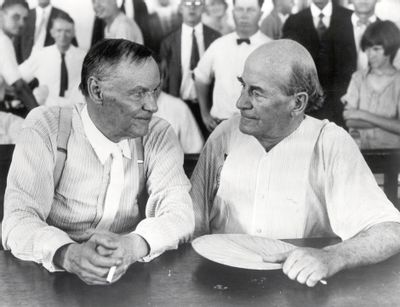
At a meeting of the Dayton Progressive Club at Hotel Aqua, John Randolph Neal introduces Clarence Darrow as “the greatest lawyer in the country. He achieved this distinction by his knowledge of his fellow man, his love of his fellow man, and decades spent defending his fellow man.”
June 23, 1925
Sue Hicks writes to Bryan that the “people of Dayton like [Darrow’s] personality and think he is a great man, but they are all shaking their heads about his beliefs.”
June 23, 1925
Charles Darwin’s son, Leonard (1850-1943), sends a letter to John Scopes saying “that which is true cannot be irreligious… May the son of Charles Darwin send you in his own name one word of warm encouragement.” Scopes burned most of the letters he got, but he kept this one.
June 26, 1925
Four days after the New York Times announced that the defense team hopes to raise $10,000 ($175,000 in 2023) for Scopes’s defense, the Chattanooga News reports that Walter White is raising money for the prosecution, claiming that “we represent the church and the public schools.”
June 27, 1925
One of the many rumors in Dayton is that “fanatics at the trial… may pollute the city’s
water source.”
June 29, 1925
Chattanooga’s school superintendent claims that evolution is not being taught in the city’s schools, despite the fact that those schools use the same textbook (i.e., Hunter’s A Civic Biology) as had been used in Dayton.
June 29, 1925
In an article titled “How Scopes Case Really Started Is Told First Time” in the Chattanooga News, Nellie Kenyon reports that, according to George Rappleyea, “the arrest of the young Rhea County high school professor for violating Tennessee’s new anti-evolution law didn’t ‘just happen.’ It didn’t grow out of a desultory debate in the store of ‘the hustling druggist.’” Rappleyea “conceived and planned” the trial. The New Yorker later called Kenyon’s reports about the origins of the Scopes Trial “a slick piece of work,” but added that the “orthodox version will pass into history like the false Washington cherry tree.”
This information is taken from “Causes Go On Forever…: A Chronology of the Scopes Trial,” by Randy Moore and Tom Davis. Copies of the book are available from the Rhea County Historical Society, P.O. Box 31, Dayton, TN 37321. Cost is $25.